The patent cliff is here: how loss of exclusivity is driving pharma BD and M&A
Hundreds of billions in revenue will lose exclusivity this decade. How the cliff is reshaping business development, how to choose between build, buy and partner, and what smaller companies should do.
 Emilio Fernandez, Owner & CEO
· 5 min read
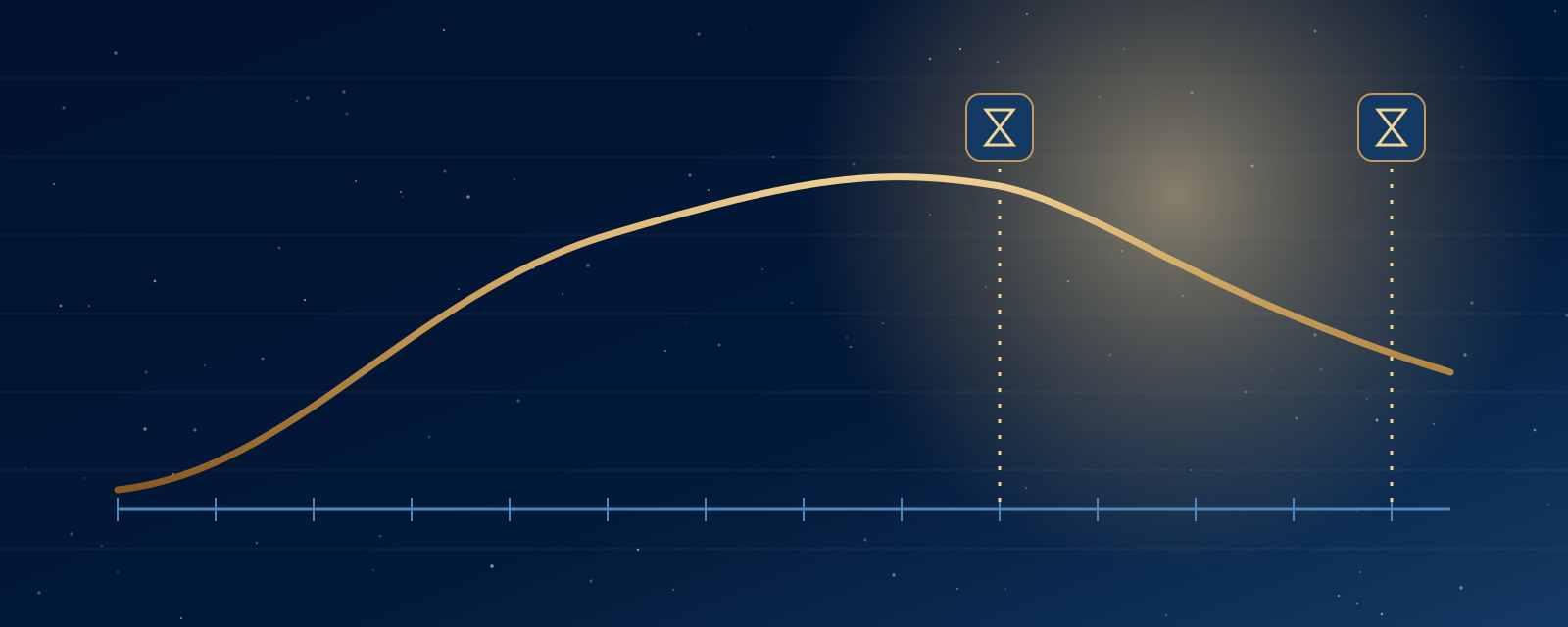
Every pharma leader lives with the calendar of patent expiries. Spend long enough in the industry and you see the same pattern: a product that defined a franchise for a decade reaches loss of exclusivity, and a large share of its revenue disappears within a few years. What is different now is the scale of what is expiring at once.
The size of the cliff
Several independent analyses point in the same direction. Evaluate estimates that more than $300 billion in prescription drug revenue will lose exclusivity between 2025 and 2030, and that large pharma's growth gap will reach $94 billion by 2030. BCG describes the current cliff as steep, similar to the last major one in the early 2000s, and notes that pricing tailwinds that helped the industry through the previous cliff are less likely this time.
Biologics are part of the wave. The IQVIA Institute expects 118 biologics to lose patent protection in the U.S. between 2025 and 2034, and found that only a small share of them had biosimilars in development as of mid-2024. Not every expiry will bring immediate competition, which makes lifecycle and launch decisions even more nuanced.
Why the cliff drives dealmaking
Internal pipelines rarely refill a gap of this size on their own, and never on the exact timeline the patent calendar demands. That is why the cliff shows up in business development budgets long before it shows up in revenue.
Evaluate's report frames the response as a mix of dealmaking, lifecycle management and stronger launches, with strategies that range from bolt-on deals to transformational M&A and portfolio refocusing. In practice, I see large companies working several levers at once:
- In-licensing and partnerships to add clinical-stage assets at a lower upfront commitment.
- Bolt-on acquisitions that bring one or two late-stage assets into an existing therapeutic area and commercial engine.
- Larger transactions when the gap is big enough that only a platform or a portfolio will close it.
- Lifecycle management of the current portfolio: new indications, formulations and evidence that extend value responsibly.
What I learned from the buyer's side
In my last role at Novartis, my mandate was to identify inorganic opportunities to support more than $3B of additional U.S. enterprise revenue by 2028. That meant screening thousands of assets and prioritizing a small number of high-potential targets. A few lessons from that work apply to anyone on either side of a deal.
The thesis comes first. The best screens start with a clear view of the gap: which therapeutic areas, which customers, which timeline. Without it, teams drown in assets.
Commercial evidence carries real weight. Buyers look hard at whether an asset fits their existing customers, field teams and access capabilities. An asset that leverages an existing commercial engine is worth more to that buyer.
Timing is a strategic variable. The value of an asset to a specific buyer depends on when their own expiries land. The same asset can be urgent for one company and irrelevant for another.
What smaller companies should do
For biotech and specialty companies, the cliff is an opportunity, but only for those who prepare.
Know your natural buyers and partners. Map which large companies face expiries in your therapeutic area, and when. That is where your asset fills a real gap.
Build the commercial case early. A credible view of the patient, the prescriber, the access path and the forecast makes an asset easier to value and harder to dismiss.
Keep options open. Partnering, licensing a territory, or launching yourself in the U.S. are all valid paths. The best negotiating position is a real alternative.
Build, buy or partner: a simple test
Not every gap needs a deal. Organic growth is usually the better path when the core still has headroom, the capability gap can be closed with better execution, and speed to scale is not the constraint. Inorganic growth earns its place when time matters more than control, the capability cannot realistically be built, or a partner brings what you lack. Inorganic does not only mean M&A: licensing, distribution agreements and partnerships are often the smartest first step.
When a leadership team asks me whether to build, buy or partner, I ask four questions:
1. What exactly is the gap? Revenue, capability, geography or time. Be specific.
2. What would it take to close it organically, and how long? Be honest about the plan, the people and the risk.
3. What would we have to believe for a deal to be better? Write the investment thesis before looking at targets.
4. Can we integrate it? If the answer is unclear, the deal is not ready, however attractive the asset.
Most companies need both: a disciplined core business that grows organically, plus a steady, selective flow of licensing, partnerships and acquisitions that extend it.
The formula view
Through the Scalar Formula, People × Culture × Strategy × Communication × Adoption × Execution = Results, the cliff is a Strategy problem that is won or lost in Execution and Adoption. A deal only fills the gap if the acquired or licensed product launches well inside the new organization, and if the teams who inherit it believe in it. I have seen strong assets lose momentum after a transaction because nobody owned the integration. The patent calendar does not wait for that.
The cliff is not new. Its scale is. The companies that come through it strongest will be the ones that combine disciplined dealmaking with launch excellence and real integration.
Sources
- Evaluate, Portfolio Tactics to Scale the Patent Cliff (October 2025)
- BCG, Patent Cliff Threatens Biopharmaceutical Revenue (2025)
- IQVIA Institute, Assessing the Biosimilar Void in the U.S.
Figures are as reported by the sources above, accessed October 2026.
Recommended for: Investors and BD / M&A